 Etherscan
 Etherscan token approvals: spending limits and revocation
Etherscan token approvals let you inspect permissions an Ethereum address has granted to token spenders and revoke supported permissions through a signed transaction. For ERC-20 tokens, an allowance defines how much a spender may transfer from that address. NFT approvals can cover one item or an operator's access to all of the owner's tokens within one contract. Reading these permissions requires only a public address; changing them requires authorization from the address which granted them. An unused spender may no longer need permission, while a recurring operation may still depend on it. Compare the original approval with the remaining allowance and the assets currently held.
Inspect approvals for the correct address
An Ethereum address identifies whose permissions the Token Approval Checker displays, and the wallet's network must match that contract state before any signed change.
Token and approved spender addresses
The ERC-20, ERC-721 and ERC-1155 tabs separate permissions by token standard. Filtering by current holdings can hide approvals for tokens the wallet no longer holds, even while the permission remains active. Use the broader approvals view to review those remaining permissions. The token contract identifies the asset; the approved spender identifies the address allowed to move it. Matching both addresses distinguishes the permission under review. A recognizable label can help identify a contract, while source code verification makes matched code inspectable. Neither property changes the permission's scope.
Authorization and confirmation
Inspection needs no wallet connection. Editing or revoking requires a connected wallet authorized to act for the approval's owner. A directly submitted Ethereum change needs ETH for gas. A zero current allowance or disabled operator status confirms the selected permission is inactive at the state you read. A transaction hash alone does not establish that change.
Allowances separate permission from token balances
An ERC-20 allowance belongs to a particular owner, token contract and spender. It lets that spender call transferFrom within the allowance and available token balance. Approval itself changes permission without transferring the approved amount. The spender and eventual recipient may be different addresses, so the approval identifies who can initiate delegated spending. A large allowance cannot supply tokens absent from the wallet, and an empty balance does not clear a persistent allowance.
Does disconnecting my wallet remove token approvals?
Disconnecting a wallet does not revoke permissions already recorded in a token contract. Disconnection ends the site's connection to the wallet; persistent onchain approvals remain active independently of that connection. Closing a browser tab also leaves that permission untouched. Connecting to the checker lets the wallet receive requests, while signing the intended revocation authorizes an onchain change.
NFT permissions for one item or an owner's holdings within one contract
NFT permissions specify which items an operator may move, so an ERC-20 spending amount cannot describe their scope.
ERC-721 approval for one NFT
approve names an approved address for a particular token ID, and getApproved reads that address. Clearing it uses the zero address, and transferring the NFT clears this item-level approval automatically.
ERC-721 operator approval
setApprovalForAll grants an operator access to the owner's NFTs within that contract. Setting its boolean argument to false removes this operator permission. Item-level approval and operator approval remain separate, so clearing one does not necessarily remove the other's access.
ERC-1155 operator approval
The standard operator permission covers the owner's token IDs within the same contract. It does not impose a separate spending quantity for each ID. isApprovedForAll reports whether the operator remains authorized. This scope extends to later holdings under that permission; it does not cover unrelated token contracts.
Reconciling an allowance after a partial spend
Consider a hypothetical wallet holding 1,157 units of an ERC-20 token, with a finite allowance of 872 units for one spender. Assume the token reduces that allowance after spending, charges no transfer fee and makes no balance adjustments. No other transactions change these values during the example.
The spender transfers 319 token units from the wallet through transferFrom, reducing the allowance to 553 units (872 minus 319). The balance falls to 838 units (1,157 minus 319), so the wallet holds more tokens than this spender can still transfer.
The original approval record can still show 872 units while the current allowance reads 553. The transferred 319 units left the wallet; the remaining allowance represents further permitted spending. It does not establish that the spender received the earlier transfer.
A successful standard revocation sets this spender's allowance to zero. Confirming zero for the same owner, token and spender verifies the permission change. The wallet still holds 838 token units because revocation changes the allowance; gas comes from its separate ETH balance.
If the transaction reverts, the allowance remains 553 units under these assumptions. Inspect the failure before submitting a corrected request, then recheck the contract state. Neither a failed nor a successful revocation recovers the 319 units already transferred.
Pending revocations and Ethereum gas
A revocation changes the effective permission only when its transaction executes successfully and the token records the intended state. While it remains pending, the spender can still use the existing allowance.
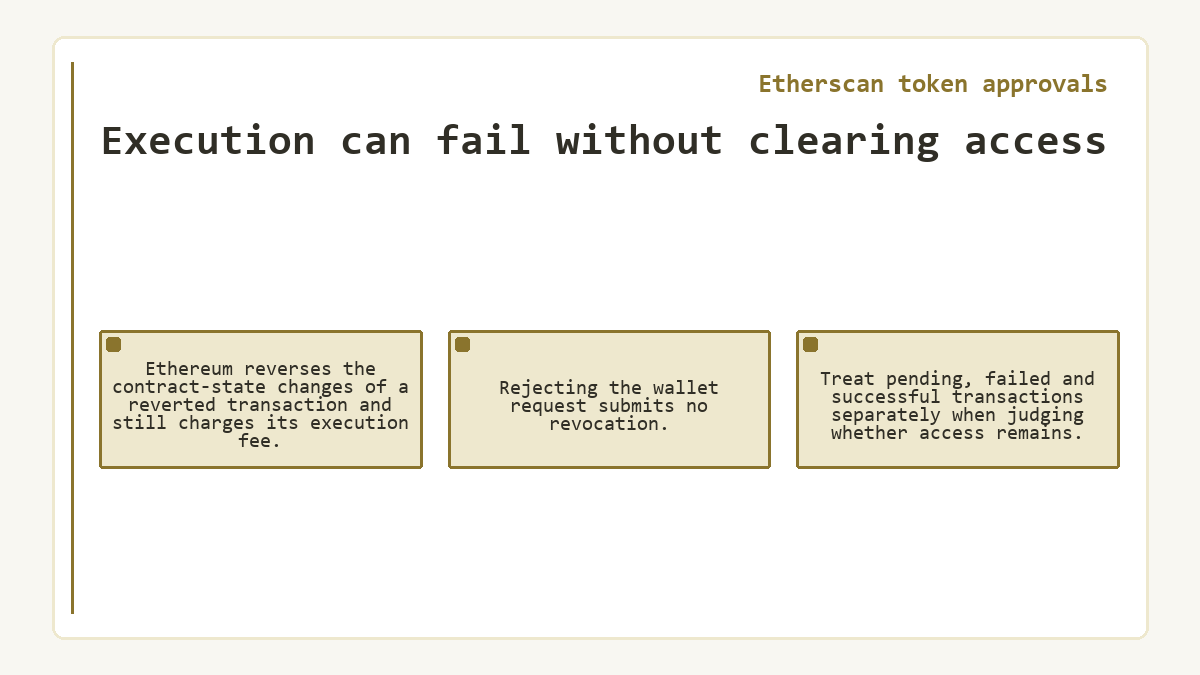
Execution can fail without clearing access
Ethereum reverses the contract-state changes of a reverted transaction and still charges its execution fee. Rejecting the wallet request submits no revocation. Treat pending, failed and successful transactions separately when judging whether access remains.
The network fee depends on execution
A directly submitted Ethereum revocation needs ETH for gas. Its fee depends on gas actually used and the effective gas price. The token's approval implementation affects the work required, while network conditions affect the price. Reading permissions does not require an onchain transaction or gas payment. The wallet's gas estimate concerns the transaction cost, not the number of token units you are authorizing.
Should I reduce an allowance or revoke the spender?
Keep a limited allowance when a known operation still needs delegated access; revoke it when you no longer want that spender to pull the token. A finite allowance limits the remaining spending quantity. An unlimited approval allows repeated access without regularly increasing the limit, and some token implementations leave that allowance unchanged after use. Existing permission can also apply to tokens received later. A smaller allowance limits the quantity exposed to that spender without changing how its contract behaves.
When changing a nonzero allowance, account for spending which may execute before your update.
A standard ERC-20 approve call replaces the spender's existing allowance with the specified value.
The standard recommends setting the allowance to zero before assigning another nonzero amount. Some tokens require this reset. Confirm the reset before establishing the new limit, and recheck any intervening spending. This does not reverse transfers already executed.
Signed permits and layered permissions
An ERC-2612 permit lets someone submit a signed authorization to update a token allowance. Its validity depends on the signed fields, the owner's current nonce and the submission deadline. Signing alone does not update the onchain allowance; the permit must execute to record the permission.
An ordinary ERC-20 approve reset does not itself invalidate an unused ERC-2612 signature, so a valid permit can establish permission again after the reset. Its submission deadline does not make the resulting basic ERC-20 allowance expire. Cancellation must follow the mechanism the token implements.
Permit2 separates the token's approval to Permit2 from application-specific authorizations. Its AllowanceTransfer module records amounts and expirations; SignatureTransfer uses single-use signatures. Removing an application's permission differs from removing the underlying token approval, which affects every application using that token through Permit2. A view of current token allowances cannot establish that every outstanding signature has been cancelled.
Individual and batch revocation choices
Etherscan supports revoking individual approvals and selecting multiple approvals through its batch revocation feature. Individual changes make a particular token and spender easier to isolate. Batch selection helps remove several unused permissions together. Review the selected calls and the wallet's proposed execution before signing, then confirm each intended permission's resulting state. A batch selection alone does not establish successful execution or a particular fee. Revoking one spender leaves other spenders' permissions intact, and future operations pulling tokens may need fresh authorization.
Revocation leaves private-key access unchanged; someone controlling the wallet's signing credentials can authorize transactions independently of a token allowance.
Practical questions
-
Can an ERC-20 approval spend the native ETH in my wallet?
- An ERC-20 allowance grants access to the specified token contract's balances, so it does not grant access to native ETH. Ethereum charges ETH separately when a revocation transaction executes onchain. Wrapped ETH is an ERC-20 token and has its own approval state, distinct from the wallet's native ETH balance.
-
Will revoking token approvals withdraw assets I deposited in a protocol?
- Revoking an approval does not withdraw assets already deposited in a protocol. It changes a spender's permission to pull tokens from your wallet. Deposited assets remain subject to the protocol's withdrawal rules, and later operations which require a spender to pull more tokens from your wallet may need a fresh allowance.
-
What does a raw allowance integer mean in token units?
- Read a raw ERC-20 allowance using the token's decimal precision. Divide the integer by ten raised to that decimal count to express it in display units. Decimal precision affects presentation without changing the stored integer. A maximum-value approval may also function as unlimited permission in the token's implementation.
-
Do token approvals carry over when I use the same address on another blockchain?
- Approvals belong to the token contract's state on a particular blockchain. Using the same wallet address on another chain does not copy its existing allowance or operator settings there. Check the chain which holds the token and its permission state; revocation on one chain does not clear a separate approval elsewhere.
-
Does receiving an ERC-20 token automatically approve its sender?
- A standard ERC-20 transfer into your address does not itself create an allowance for the sender. Receiving a token changes its balance, while approval requires a separate authorization mechanism. Existing permissions can still remain active, so the incoming transfer alone tells you nothing about any allowance you granted earlier.
-
What does an old approval date tell me about expiration?
- An approval date identifies when the recorded authorization occurred; it does not establish an expiration date. Basic ERC-20 approval has no standard expiry parameter. A permission system with explicit expiration rules can behave differently, so distinguish the displayed age from any deadline or expiry the authorization mechanism actually enforces.
Last updated ·